

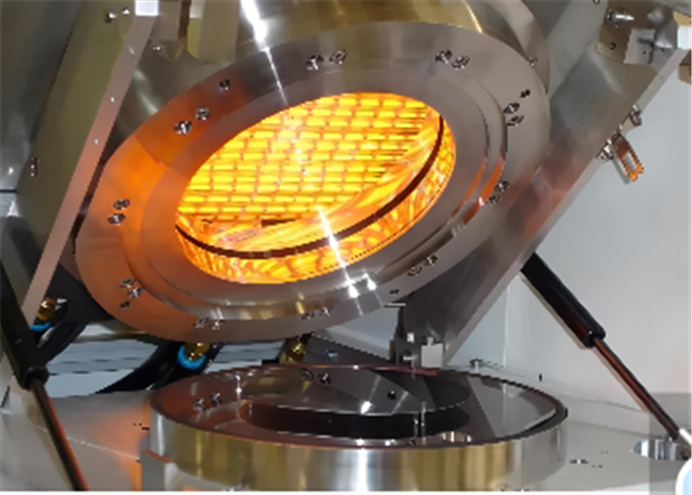
On the lithography floor, the bake isn’t a warm-up. It sets the photoresist profile. A 2°C drift in soft bake or hard bake will throw off critical dimension control and leave scum along the line. The spin coater bake lamp has one job: hold process temperature with repeatability, minute after minute. What matters under the hood We spec short-wave infrared halogen emitters in a quartz envelope because they respond fast and stay stable. That gives wafer-level thermal uniformity within ±0.1°C across the hotplate, and photoresist bake temperature precision that keeps the thermal budget tight. Cleanroom Class 1–100 compatibility is baked into the design: low-outgassing materials and a particle-controlled path. Zero particle generation isn’t a slogan—it’s the baseline. The system runs 24/7 without unplanned downtime, and repeatability comes from closed-loop control that compensates for line voltage swing and lamp aging. Why it holds up in production You need the bake to match the recipe, not the other way around. This lamp stabilizes the spin coater bake zone so soft bake and hard bake consistently remove solvent and drive crosslinking. The payoff is better yield and less scrap. Energy use drops because the response is quick and dwell is short. Fewer lamp swaps also means less maintenance traffic in the cleanroom. When temperature stops being the variable you chase, the process window opens up. What to keep in mind Installation comes down to matching the spin coater’s mechanical interface and control signals. Retrofit kits vary by platform and connector type. The lamp is sensitive to cooling airflow and hotspot management—keep the air path as specified and clean the quartz on schedule. After a lamp change, give it a short warm-up stabilization period before you lock in the bake curve.